
There is more than one way to mount a motor
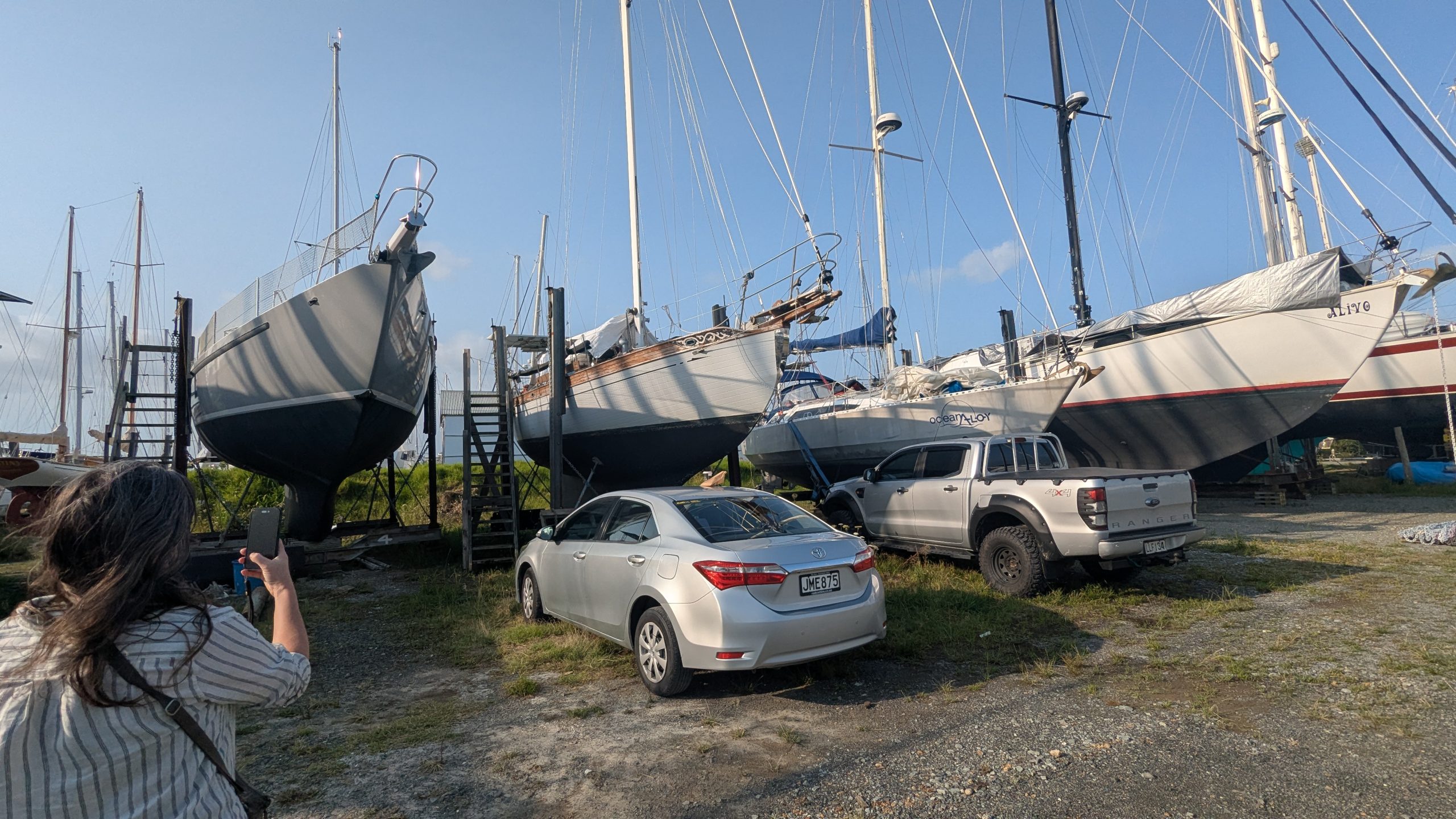
We returned to New Zealand after a full day of airports and seats clearly designed by someone who has never sat in one for more than ten minutes. From there it was a rental car and a three-hour drive to the yard where Meriwether had been waiting patiently for the past seven months.
We knew better than to move straight back aboard. Seven months sealed up in a damp yard meant mold. A lot of mold. And we needed a serious grocery run before becoming liveaboards again. So we booked a few nights in a hotel. Kerri worked during the day while I made daily trips to the boat to begin the resurrection. Every single surface had to be de-molded. Every dish, fork, spoon, pan, towel, and piece of bedding had to be washed. It felt less like moving back aboard and more like recommissioning something that had spent time underwater. By day four the air no longer smelled suspicious, the linens were clean, and we could finally move back in.
-

- Meriwether awaits our return
-
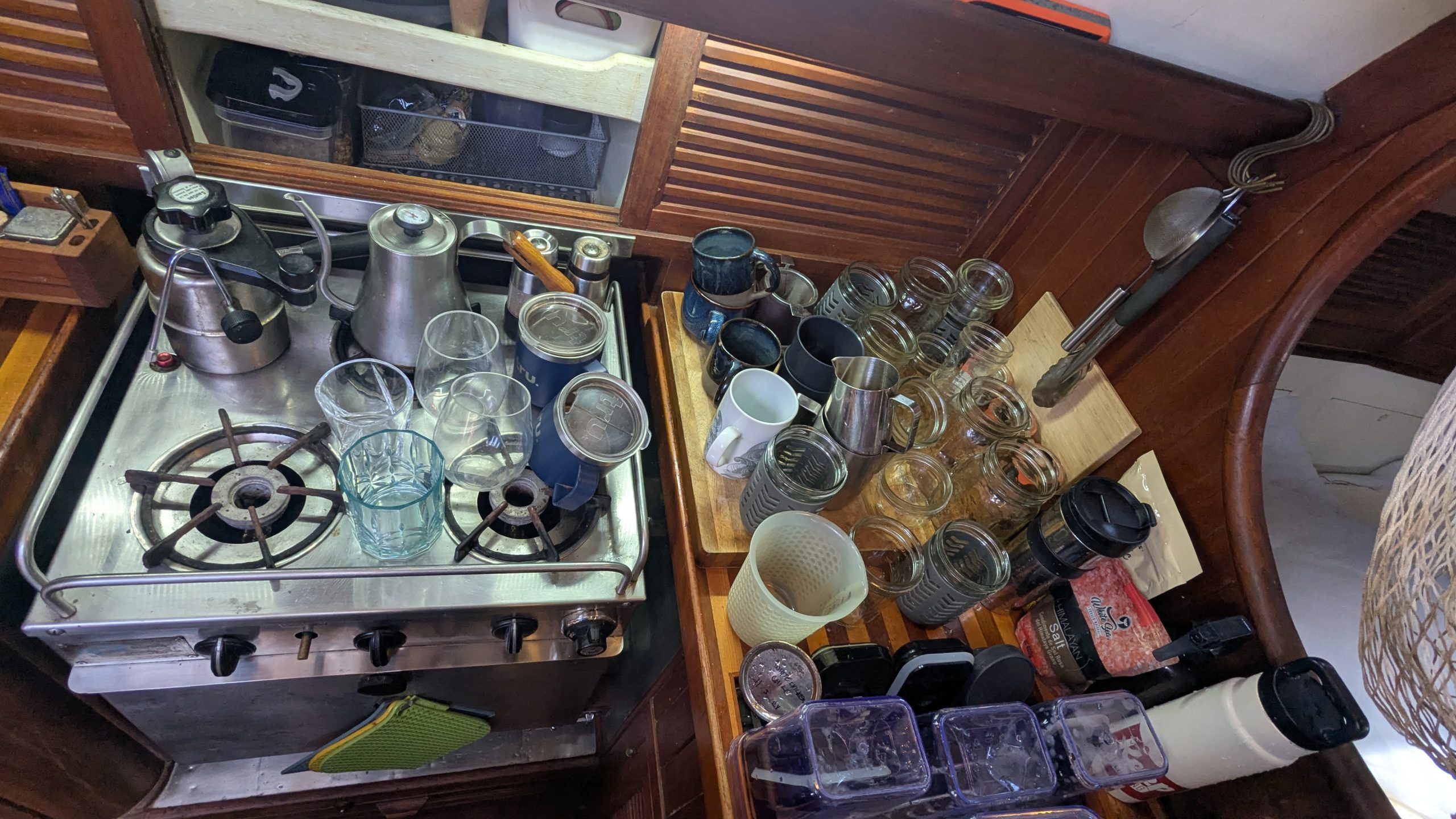
- Seriously, how many cups/glasses/mugs do two people need?
We had a long list of critical jobs that had to be completed before the boat could go back in the water, and an even longer list of general to-dos that would wait in the shadows. Naturally, we started with something buried deep in the mechanical anatomy of the boat.
One of the first critical items was replacing the cutlass bearing — the bronze sleeve the prop shaft passes through between the transmission inside and the propeller outside. Meriwether’s mechanical backside. To get to it, the prop had to come off. I’d never removed one before. A yard manager showed up with a hydraulic prop puller, gave it a minute or two of effort, stepped back admitting defeat, and quickly began offering increasingly complicated alternatives. I stepped in and kept turning the screw. With a thunderous ping, the bronze prop finally let go of the stainless shaft. Sometimes the answer is just more brute force.
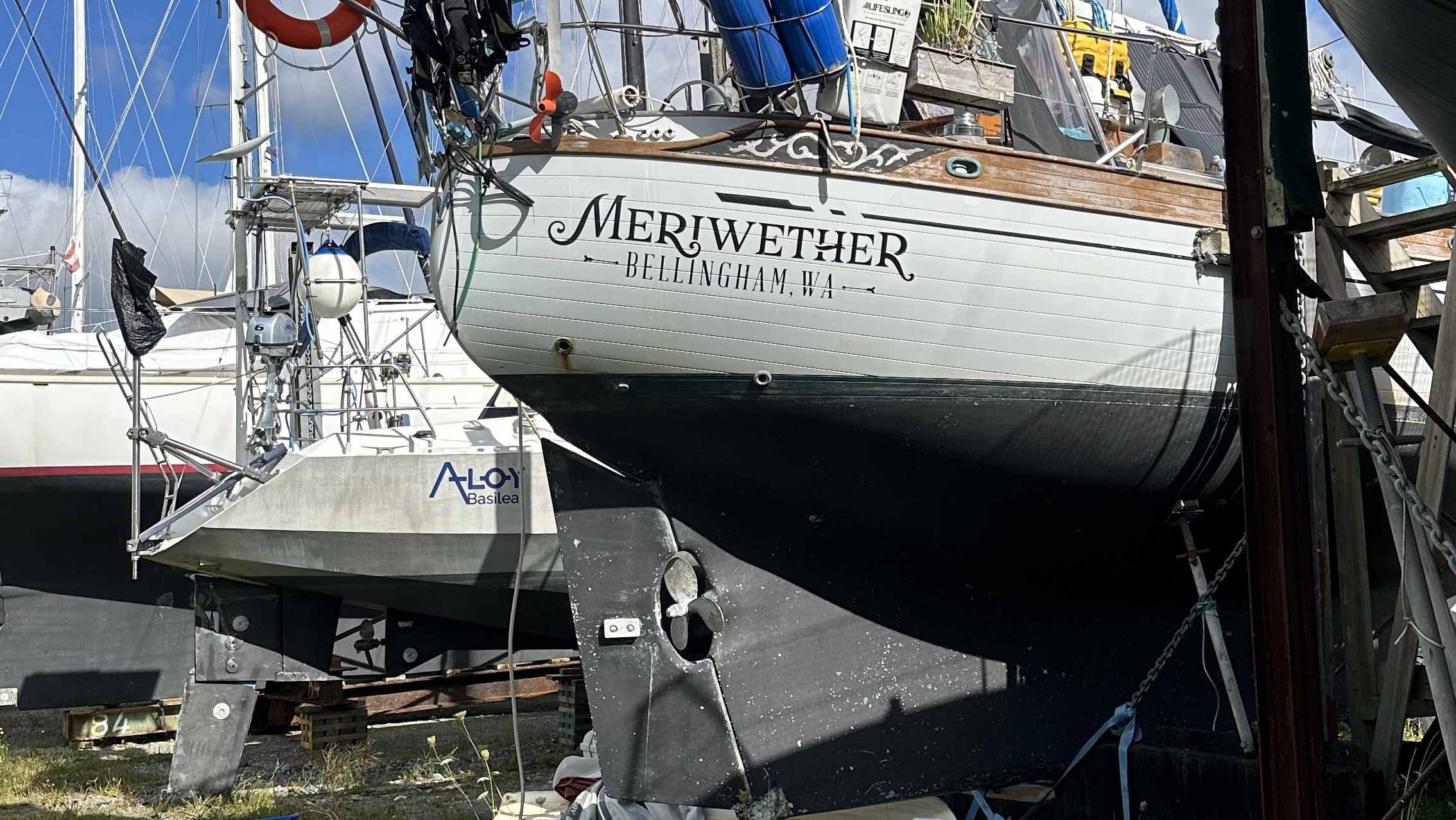
A look at Meriwether’s rump
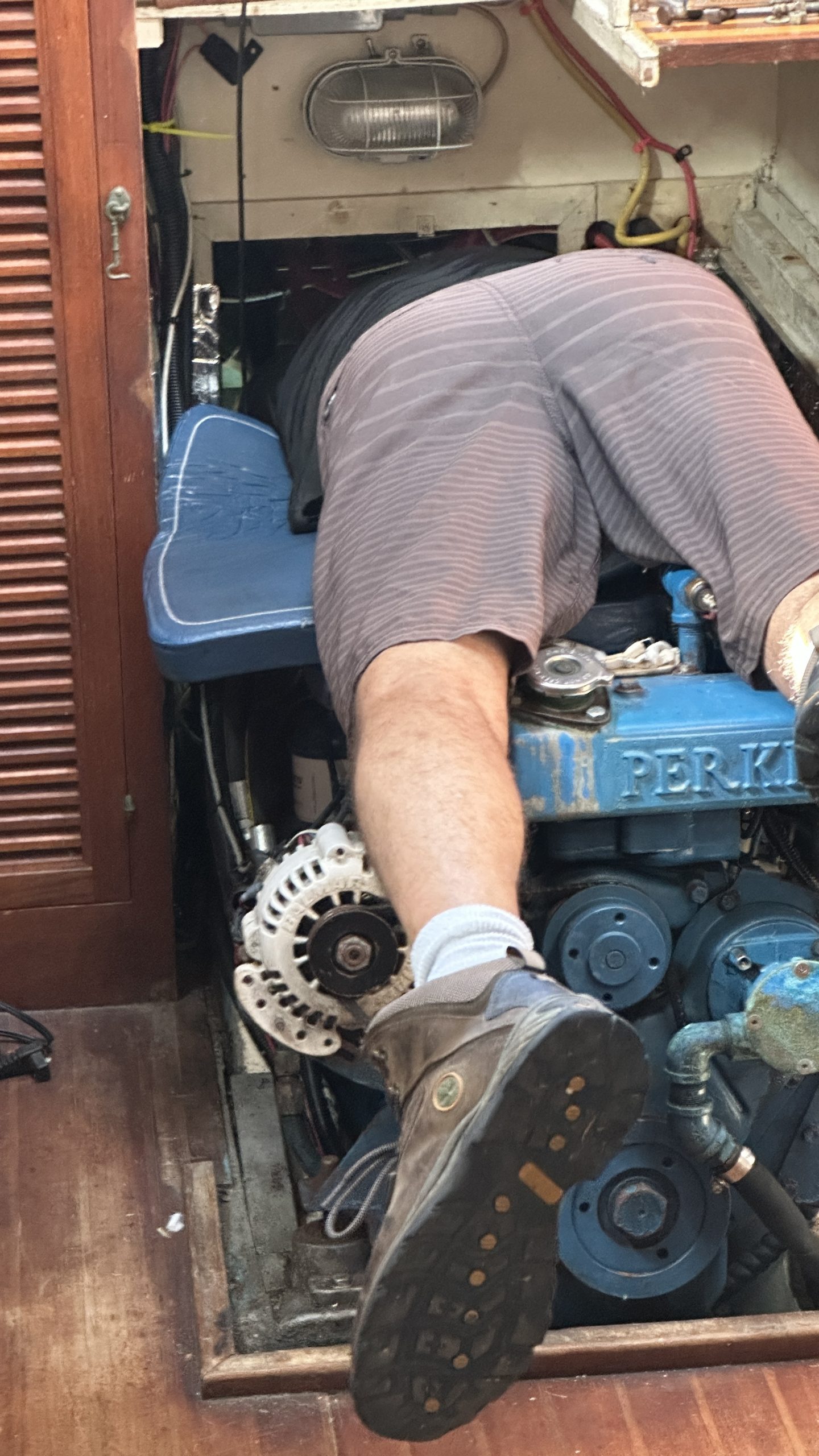
A look at my rump as I “mount” the motor
The shaft coupler at the transmission end put up a much bigger fight. That job took half a day lying across the top of a rusty diesel engine, hammering two stubborn pieces of unlike metal apart. Behind the engine is a tiny space that exists for exactly two purposes: to allow the shaft to exit the boat, and to swallow tools into the bilge. Swinging a hammer in there allowed about two inches of motion. It was slow, awkward work, but eventually the coupler surrendered.
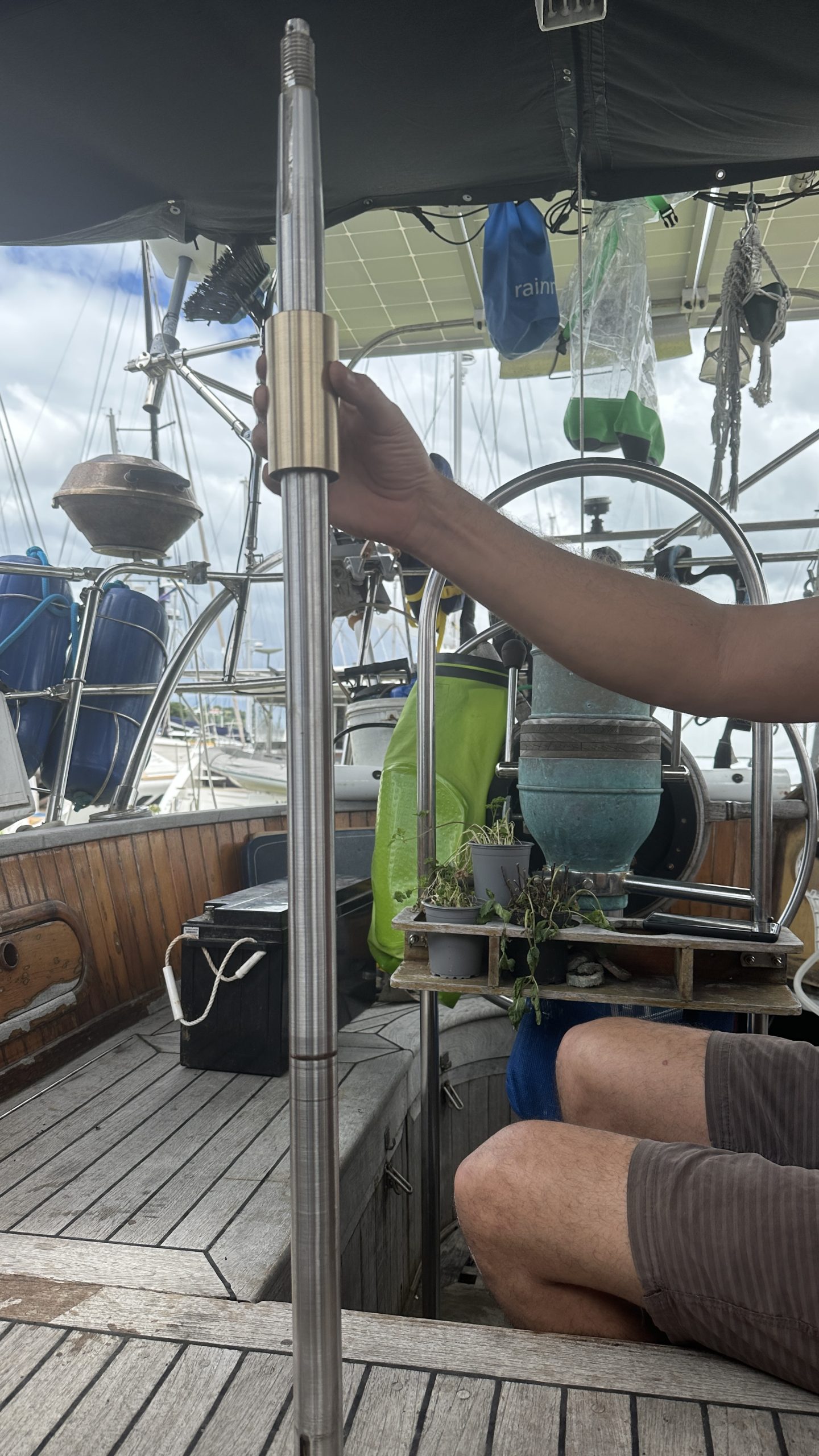
Shaft and cutlass bearing ready for install
With the shaft finally out, I could turn to the cutlass bearing itself. My experience consisted entirely of watching YouTube sailors battle theirs for a week. That was my expectation. However a different yard manager suggested using a slide hammer. We cobbled one together and got to work. Two minutes in he too gave up and recommended pulling the entire engine and transmission so we could push the bearing out from the inside.
Two minutes.
Again, I stepped in with more brute force. The American way. Less than a minute later the old bearing popped free and landed in my hand. The new one went in with steady taps from a rubber mallet. No engine removal required. I can’t help but judge the country as a whole based on these two men’s timid nerves.
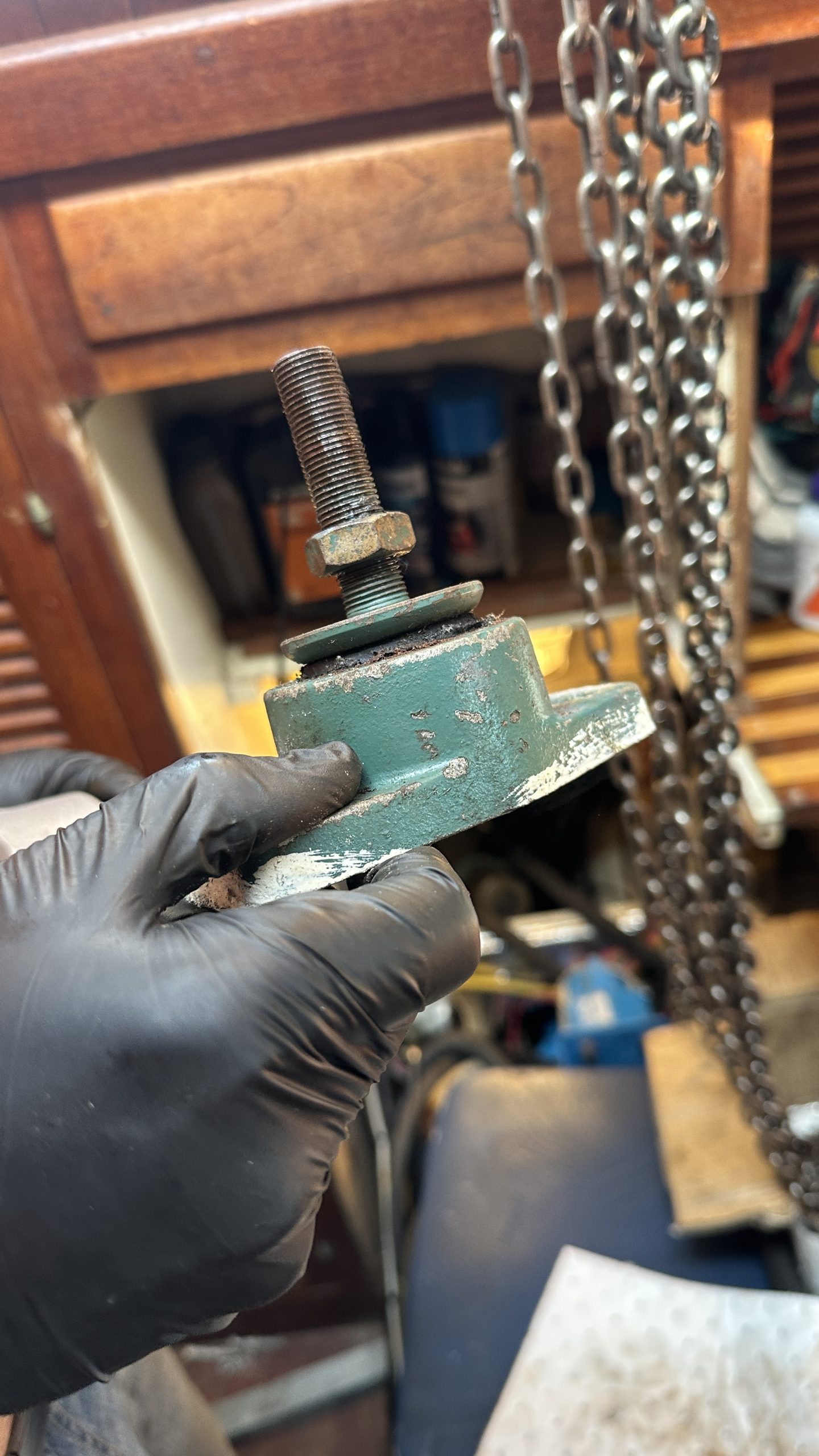
One of the old motor mounts ready for replacement
The worn bearing wasn’t the root issue. At least one — probably two — of the engine mounts had finally given up, allowing the drivetrain to shift just enough to cause premature wear. Calling the mounts “old” would be generous. This was a job I should have done in Mexico when the engine was out. Or when we first arrived in New Zealand and the engine was out. I had actually tried then, but the mounts were only available in the U.S., and shipping would have taken too long. So we ordered them in the States and carried them back with us in the luggage.
Replacing them meant lifting the engine again — something I’ve now done more times than I care to admit. With the engine hanging above my workspace, I contorted fingers into narrow fiberglass slots to remove eight nuts. Once the old mounts were out, I reversed the process to install the new ones — same cramped space, same awkward reach, same careful alignment. Another full day of sweat, grunts, and cramped limbs. But the mounts were in. The drivetrain sat steady again.
By this point we are more than three weeks into projects. Most of my days had been spent folded into compartments not designed for humans. But progress had been made. Major critical jobs were completed. The prop reattached to the shaft. The shaft reconnected to the transmission. A new cutlass bearing sat properly seated. The stuffing box was repacked. And the engine now rested on four fresh motor mounts. Meriwether’s backbone was solid again.
There was still plenty left on the list. But the heart of the boat — the part that turns diesel into motion — was ready. I think.



It was a nice noise when the prop came loose I’ll bet!
A huge relief, for sure.